
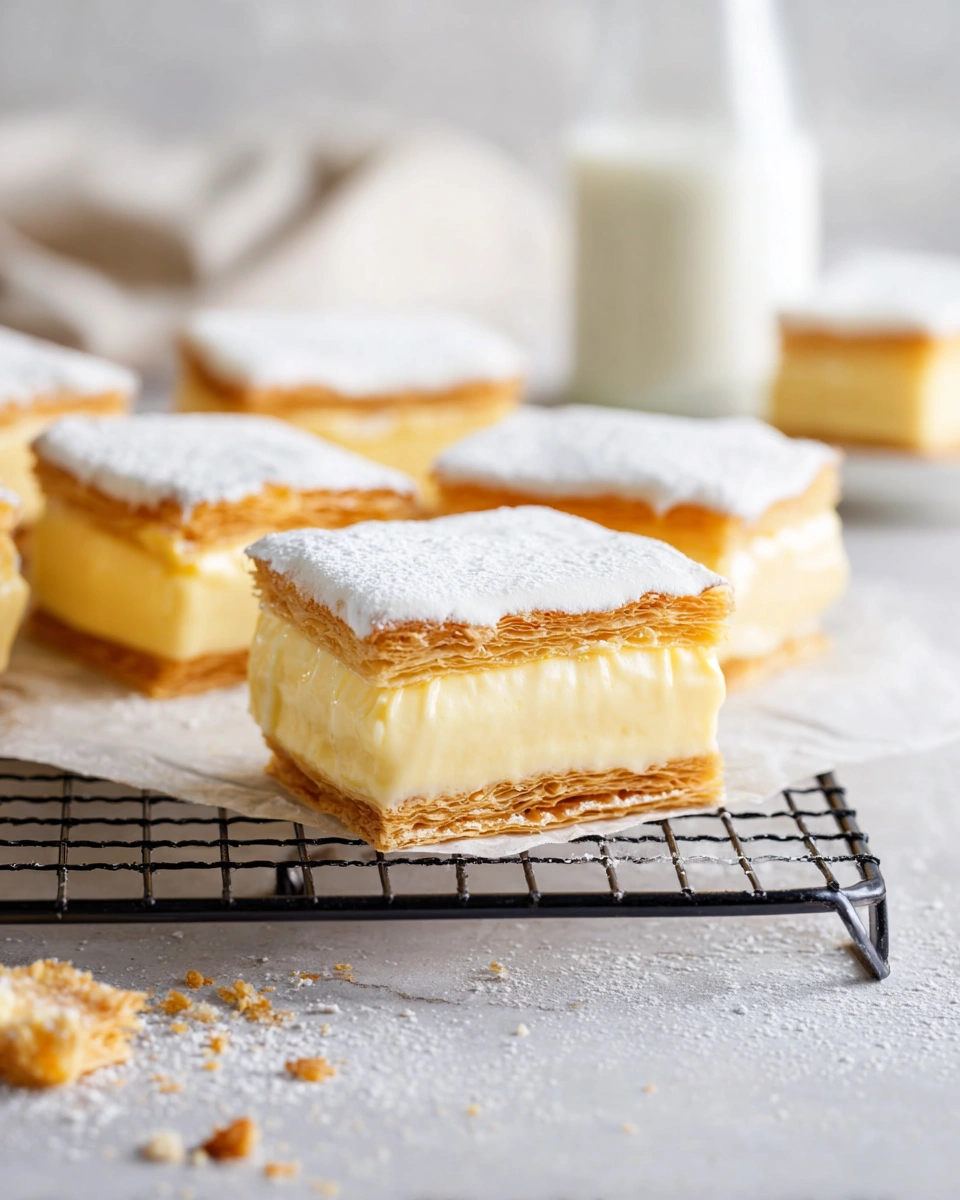
Custard square (often called custard slice or vanilla slice) is a bakery-style dessert made from two crisp sheets of puff pastry with a thick layer of set vanilla custard in the middle, finished with a simple vanilla icing. This version follows the same components + weight-based approach used in the recipe you shared from Cloudy Kitchen (puff pastry, custard filling, icing), but the instructions below are written fresh and original.
Yield + Time
- Yield: about 12 squares
- Best plan: make over 2–3 days (puff pastry → bake + fill → chill → ice + slice).
Ingredients (with grams)
1) Homemade Puff Pastry
Butter block
- 450 g unsalted butter, room temperature
- 70 g bread flour
Dough (détrempe)
- 400 g bread flour
- 200 g all-purpose flour
- 1½ tsp fine sea salt
- 115 g unsalted butter, room temperature
- 1 Tbsp vanilla bean paste (optional)
- 290 g cool water
2) Vanilla Bean Custard Filling
- 720 g whole milk
- 480 g heavy cream
- 2 tsp vanilla bean paste
- pinch of salt
- 65 g custard powder (see note below for cornstarch swap)
- 200 g sugar
- 3 eggs, room temperature
- 70 g unsalted butter, room temperature
3) Vanilla Icing
- 375 g powdered sugar, sifted
- 45 g unsalted butter, room temperature
- ½ tsp vanilla bean paste
- whole milk, a few tablespoons (as needed)
Equipment (helpful)
- Rolling pin + ruler
- 2 sheet pans
- Parchment paper
- Another sheet pan (to “weight” pastry while baking)
- 9×13 in (23×33 cm) pan or similar slice pan
- Whisk + medium saucepan
- Fine sieve (optional, for extra-smooth custard)
Step-by-Step Instructions
Day 1 (optional but recommended): Make the puff pastry
Step 1 — Make the butter block
- In a bowl, mix 450 g butter with 70 g bread flour until smooth and fully combined.
- Shape into a neat rectangle (about 1–2 cm thick), wrap well, and refrigerate until firm but pliable (it should bend slightly without cracking).
Step 2 — Make the dough
- Mix the bread flour, all-purpose flour, and salt in a large bowl.
- Rub in the 115 g butter until you have a sandy texture with some small butter pieces.
- Add cool water (and vanilla paste if using). Mix just until a dough forms.
- Shape into a rectangle, wrap, and chill 30–60 minutes.
Step 3 — Lock in the butter
- Roll the dough into a rectangle large enough to wrap around the butter block.
- Place the butter block in the center and fold the dough around it, sealing edges so the butter is fully enclosed.
- Chill 20–30 minutes if the butter feels soft.
Step 4 — Do your turns (folds)
You’re building layers. Work on a lightly floured surface and keep everything cold.
- Roll the dough into a long rectangle.
- Turn 1: do a 4-fold (book fold) → chill.
- Turn 2: do a 3-fold (letter fold) → chill.
- Turn 3: 4-fold → chill.
- Turn 4: 3-fold → chill.
Tip: If the dough resists rolling or the butter starts to melt, stop and chill. Clean layers = flaky pastry.
Wrap tightly and refrigerate overnight (or freeze for later).
Day 2: Bake pastry sheets + cook custard + assemble
Step 5 — Roll and bake two pastry sheets
- Heat oven to about 200°C / 400°F (a typical puff pastry baking temp).
- Divide puff pastry into two equal pieces.
- Roll each into a thin rectangle sized to fit your pan (or your desired final slice size).
- Place each sheet on parchment-lined baking trays.
- Dock all over with a fork (helps control puff).
- Place another sheet pan on top to weight the pastry so it bakes flat and crisp.
- Bake until deep golden and fully crisp. Cool completely.
If one tray finishes earlier, remove it—overbaked pastry can taste bitter.
Step 6 — Cook the vanilla custard
- In a saucepan, warm milk + cream + vanilla + salt until steaming (not boiling).
- In a bowl, whisk custard powder + sugar first (this helps prevent lumps), then whisk in the eggs until smooth.
- Slowly pour a little hot milk/cream into the egg mixture while whisking (tempering).
- Pour everything back into the saucepan.
- Cook over medium heat, whisking constantly, until thick and bubbling (you want it to fully activate the starch so it sets well).
- Remove from heat and whisk in the 70 g butter until glossy.
- Optional: pass through a sieve for ultra-smooth custard.
- Let custard cool 10–15 minutes so it’s thick but still spreadable.
Custard powder note: the Cloudy Kitchen post uses custard powder and mentions cornstarch as a substitute if needed. A common swap is using cornstarch in a similar quantity by weight, though results can taste slightly less “custard-y.”
Step 7 — Assemble the custard square
- Line your pan with parchment, leaving overhang for lifting.
- Place one baked pastry sheet in the bottom (trim to fit).
- Pour/spread the custard evenly over the pastry.
- Add the second pastry sheet on top, pressing gently to level (don’t crush it).
Step 8 — Chill to set
Refrigerate at least 4 hours, but overnight is best for clean slices and a fully set custard.
Day 3 (or later): Ice + slice
Step 9 — Make the vanilla icing
- Mix powdered sugar + butter + vanilla.
- Add milk little by little until you get a thick, spreadable icing (it should slowly settle smooth, not run).
Step 10 — Ice the top
Spread icing over the top pastry layer. Chill 15–30 minutes to set the icing.
Step 11 — Slice neatly
For clean slices:
- Use a sharp serrated knife for the top pastry.
- Wipe the knife between cuts.
- You can score the top pastry first, then cut straight down.
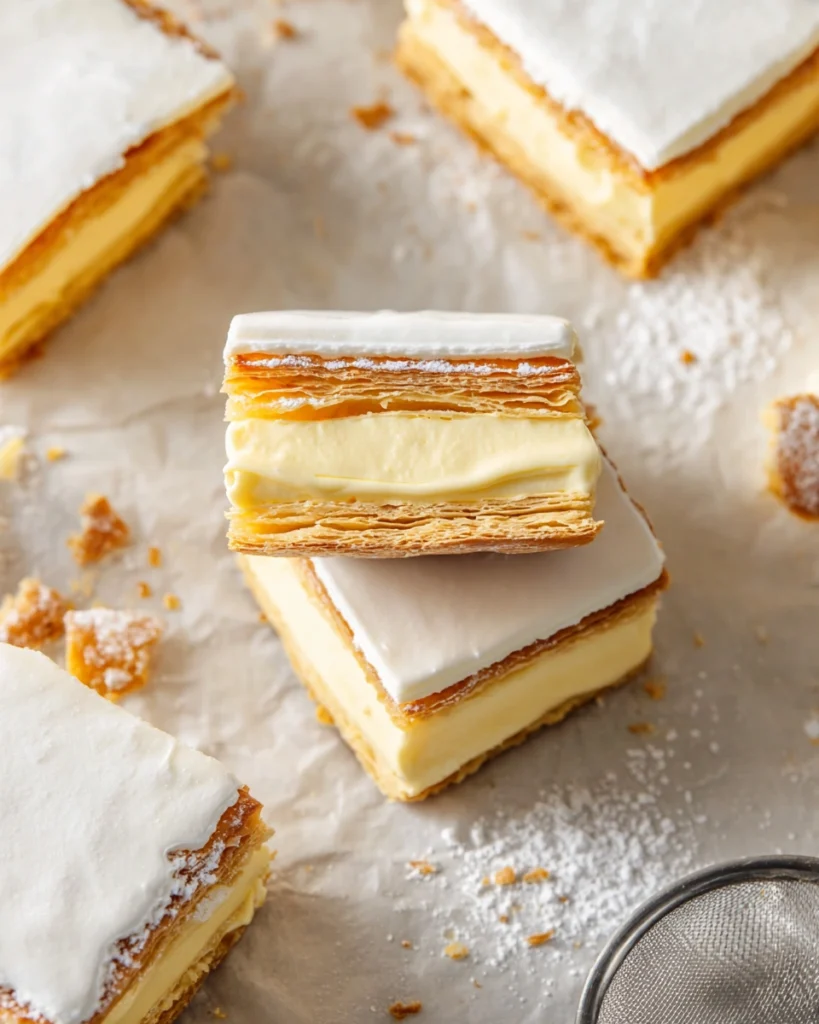
Lift out using parchment overhang, then cut into squares.
Storage
- Keep refrigerated in an airtight container 2–3 days (pastry softens over time, but it’s still delicious).
- Best texture: day 1–2 after assembly.
Shortcut Options (if you want)
- Use store-bought puff pastry to save time (still great).
- Or make rough puff (faster than classic puff) if you’re comfortable with it—Cloudy Kitchen also discusses these alternatives.